

Creatine: A Secret Weapon After a Sleepless Night?

How Creatine Fits Into the Conversation Around Sleep, Stress & Mental Fatigue
We’ve all had nights where sleep doesn’t come easily. Maybe it’s travel, stress, a racing mind, or the feeling of staring at the ceiling while mentally calculating how little sleep you’re about to get before an important morning.
And while no supplement replaces sleep, researchers have become increasingly interested in how certain nutrients may help support cognitive function during periods of stress, fatigue, and sleep deprivation.*
Creatine is one of them.
Beyond the Gym
Creatine is often associated with strength training and performance — and for good reason. It’s one of the most extensively studied supplements in the world, with decades of research supporting its role in strength and exercise performance.*
But emerging research has also expanded into cognition and cellular energy.
Creatine helps support the body’s natural ATP regeneration process, the energy system cells rely on to function.* Because the brain is one of the body’s most energy-demanding organs, researchers have become increasingly interested in how creatine may support cognitive function under demanding conditions like fatigue, stress, and sleep deprivation.*
What the Research Is Exploring
Sleep deprivation can affect areas of cognitive performance including attention, memory, reaction time, and mental fatigue.
Recent studies have explored whether creatine supplementation may help support certain aspects of cognitive function during periods of reduced sleep.* Some early findings have shown differences in measures related to short-term memory, processing tasks, and mental fatigue in sleep-deprived individuals, though the research is still evolving.
Researchers believe this may relate, in part, to the brain’s increased energy demands during periods of stress or fatigue.*
Importantly, creatine is not a stimulant. It does not create artificial energy or replace rest. Sleep remains foundational for overall health, recovery, and cognitive performance.
Consistency Matters More Than Extremes
One of the biggest misconceptions around creatine is that it needs to be complicated.
For most people, a consistent daily serving of creatine monohydrate is enough to support long-term use over time.* Some emerging cognition-focused research has explored larger or loading-style protocols, but that research is still developing.
That’s why Arrival keeps things simple:
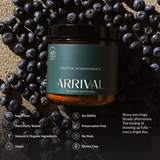
5g of creatine monohydrate — the amount most commonly used in research-backed daily protocols.*
A More Thoughtful Approach
At Arrival, we’ve always been interested in the broader conversation around creatine — not just performance in the gym, but the role cellular energy plays across real life.
The long days.
The early mornings.
The travel.
The stress.
The constant mental load modern life asks women to carry.
Not because creatine replaces the foundations of health.
But because supporting the systems your body already relies on matters, too.*
Note: This article is for informational purposes only and is not intended as medical advice. Always consult with a qualified healthcare provider before starting any new supplement regimen.
*These statements have not been evaluated by the Food and Drug Administration. This product is not intended to diagnose, treat, cure, or prevent any disease.