

Creatine is one of the most extensively studied supplements in the world, with decades of research spanning strength, recovery, cognition, and healthy aging. Yet for years, much of the conversation around creatine remained narrowly focused on performance alone.
Emerging research suggests creatine metabolism may differ across women’s life stages, influenced in part by muscle mass, dietary intake, and hormonal changes throughout the menstrual cycle and menopause. That shift in research is part of why creatine is being discussed more seriously within women’s health today.*
About 95% of the body’s creatine is stored in skeletal muscle, and women generally carry less muscle mass to store it. On top of that, many women consume less dietary creatine than men, especially if they do not eat red meat regularly.
The science continued evolving. The conversation often did not.
Built on the research.
The Science

Over a thousand peer-reviewed creatine studies. Decades of documented research. What was missing wasn’t the science — it was a product that felt as thoughtful as the women choosing it.

More than a muscle supplement.
Your brain relies on ATP to function. Creatine helps support the body’s natural ATP regeneration process — helping support cognitive function, mental energy, and focus.*
Emerging research suggests creatine may play a role in memory and cognitive performance, particularly during periods of stress, fatigue, or aging.*
Arrival is built around the full picture.
Creatine is one of the most researched supplements in existence. Over a thousand peer-reviewed studies.


Brain + Cognition

Your brain relies on ATP to function. Creatine helps support the body’s natural ATP regeneration process, helping support focus, mental energy, and cognitive function.*


Bones + Strength

Bone health is built over decades. Resistance training is one of the most important tools for supporting it, and creatine is well studied alongside it for strength and muscle support.*


Energy + Mood

Creatine helps support the body’s natural ATP regeneration process — the energy your cells rely on to function.* Emerging research continues to explore creatine’s role in cognitive function, mental fatigue, and resilience during periods of stress and demanding conditions.*
Brain + Cognition
The brain accounts for roughly 20% of the body’s energy use. That energy relies on ATP — and creatine helps support the body’s natural ATP regeneration process.*
In women, this becomes especially interesting because hormonal changes may influence creatine synthesis, transport, and utilization across different life stages, from the menstrual cycle through menopause.
That is part of why creatine is being discussed more seriously in women’s health, with emerging research exploring its potential role in cognitive function, memory, attention, and mental fatigue.*
Bones, Strength + Recovery
Bone mass peaks around age 30 and gradually declines over time, with bone loss accelerating during the menopause transition. Research suggests women can experience accelerated bone loss during these years.
Resistance training remains one of the most important tools for supporting healthy aging, strength, and bone health. Creatine helps support the body’s natural ATP regeneration process during high-intensity effort and is one of the most extensively studied supplements for strength and muscle support.*
In older women, research suggests creatine supplementation alongside resistance training may help support strength, muscle function, and healthy aging over time. It has also been studied alongside resistance training in postmenopausal women for its potential role in supporting bone health.*
The earlier you build strength, the more you have to protect.
Mood + Energy
Not all fatigue is physical. Mental energy depends on the same cellular energy systems as the rest of the body — and creatine helps support the body’s natural ATP regeneration process.*
Emerging research continues to explore creatine’s potential role in cognitive function, mental fatigue, and resilience during demanding conditions such as sleep deprivation and stress.*
Supplementing doesn’t create energy — it helps support the systems your cells already rely on.
A well-studied ingredient, held to higher standards.
A clean, thoughtful take on a well-studied ingredient.


The science evolved. The conversation is catching up.


Creatine Monohydrate
Creatine monohydrate is the form used in the vast majority of creatine research. It’s the most studied and established form, with decades of research supporting its use across strength, recovery, and performance.* We didn’t try to reinvent the ingredient. We chose the form the research continues to return to.
5g in every serving — the daily dose most commonly used in research

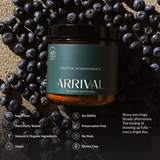
Organic Blueberry
Organic Blueberry Powder
Real fruit. Not “natural flavor.” Just organic blueberry powder made from whole blueberries that are dried and milled. Nothing unnecessary added.
It earns its place in the jar twice over. First, for flavor — mild, clean, and subtle enough to disappear into whatever you mix it with rather than competing with it. Second, for what naturally comes with real fruit: blueberries contain anthocyanins and polyphenols, compounds widely studied for their role in overall wellness.
In a product designed around thoughtful daily support, that’s not a coincidence. It’s a decision.

This is what clean actually looks like.
Real ingredients. Thoughtfully chosen.

 Sugar Free
 Third Party Tested
 Natural & Organic Ingredients
 Vegan
Vegan
 No GMOs
 Preservative Free
 No Nuts
 Gluten Free
Sharp mornings. Steady afternoons. The feeling of showing up fully — every single day.
Shop Arrival